Why the Same Question Gets a Different Answer Every Time
For professionals and leaders who suspect there's more thinking available in the room than they're currently accessing.
The Cards We're Dealt

I sometimes think of cards and card games as a metaphor for life.
Each of us is dealt our cards. We're required to play them as best we can. And each card, at any given moment, has the power to influence and change our direction.
I've been thinking about this for a long time. Long enough to turn it into something real.
I designed a set of question cards and board games for my events and workshops because they unlock conversations.
We can play with the cards and games in various ways.
One of the most popular is when each person is dealt five cards and they take turns to respond. The questions are crafted to encourage genuine participation, not performance. The conversations that follow are not about selling services. They're about who you are, what you do, and how you operate.
Same question. Same room. Completely different answers.
One of the most memorable “What does “success” look like to you?
Sometimes, depending on the card, people name the same trend, the same challenge, the same hope. Heads nod. There's something reassuring in that, the recognition that others see what you see. That you're not imagining it.
But then someone says something nobody else has considered. You can feel the shift. A pause. People leaning in. Someone saying quietly, "I've never thought of it that way."
That moment. That's why conversations matter.
Not because everyone agrees. Because they don't.
Influence and Change
When I wrote my book back in 2018, I turned to the Oxford Dictionary to help explain what I was observing in those rooms.
Influence: the capacity to have an effect on the character, development, or behaviour of someone or something.
Change: an act or process through which something becomes different.
Both happen in a good conversation. Often at the same time. Often without anyone realising it until later, when they're driving home and something someone said is still sitting with them.
By being candid, we tap into our power to influence people, initiate relationships and inspire transformation.
That's not a theory. That's what I've watched happen, again and again, when the right question lands in a room full of people who are genuinely present to hear each other's answers.
The Thinking We Don't Know We're Missing

In most environments, siloed thinking is rarely a choice. Nobody decides to stop being curious or to seek out only people who already agree with them. It happens gradually. Quietly. We get busy. We stay in our lane. We have the same conversations with the same people and call it staying connected.
And then someone in a room says something that stops us.
Not because they're smarter. Not because they have access to information we don't. Because they've lived a different version of the professional experience and that difference is exactly what our thinking needed.
Every voice in the room is a perspective we don't have yet. That's not a nice idea. That's the whole point.
I've watched people leave a single conversation with a clearer sense of where their industry is heading than they had after months of reading reports alone. Not because the conversation gave them data. Because it gave them a different angle on the data they already had.
That's what diverse perspectives do. They don't just add to our thinking. They reorganise it.
When You Hear Yourself in Someone Else's Words
There's another thing that happens in these rooms that I find just as powerful.
Someone shares their answer. And someone across the table says, almost involuntarily: "Yes. That's exactly it."
Not agreement on a trend or a strategy. Recognition. The feeling of being seen in your own experience, of discovering that the thing you thought was specific to you, your business, your situation, is actually something others are navigating too.
That recognition does something to people. It reduces the weight of it. It opens up the conversation. And often it's the moment someone stops holding back and starts actually contributing.
When people feel understood, they think better. That's not a theory. I've watched it happen.
This is what gets lost when we only have conversations within our own circle. We miss the mirror. The moment of recognition that reminds us we're not alone in this, and that the path forward might already exist in the room, in someone else's experience, if we create the conditions to hear it.
What People Actually Report
Business owners and professionals who experience this kind of deep participation consistently report four things:
Better communication and stronger connection with the people around them.
Increased contribution and commitment, because they feel genuinely seen and heard.
Clearer focus on their personal goals, their business goals, and the goals they share with others.
And stronger motivation to reach their full potential.
Not because someone told them what to do. Because a conversation opened something up that a report, a podcast, or a strategy session alone couldn't reach.
Influence doesn't require authority. It requires a genuine conversation with someone whose experience is different from yours.
Every Voice Carries Something the Room Needs
I've facilitated enough sessions to know this with certainty: the insight that shifts the conversation is rarely the one you expected.
It doesn't always come from the most senior person. Or the loudest. Or the one with the most impressive title.
It comes from the person who almost didn't speak. Who wasn't sure their perspective was relevant. Who needed the question to be asked in a certain way, or the room to feel safe enough, before they'd say what they were actually thinking.
And when they do, something happens. Heads nod. People lean in. Someone says "I've never thought of it that way" and means it.
That's what better thinking actually looks like. It's collaborative. It requires different voices. And it depends entirely on whether those voices feel welcome enough to speak.
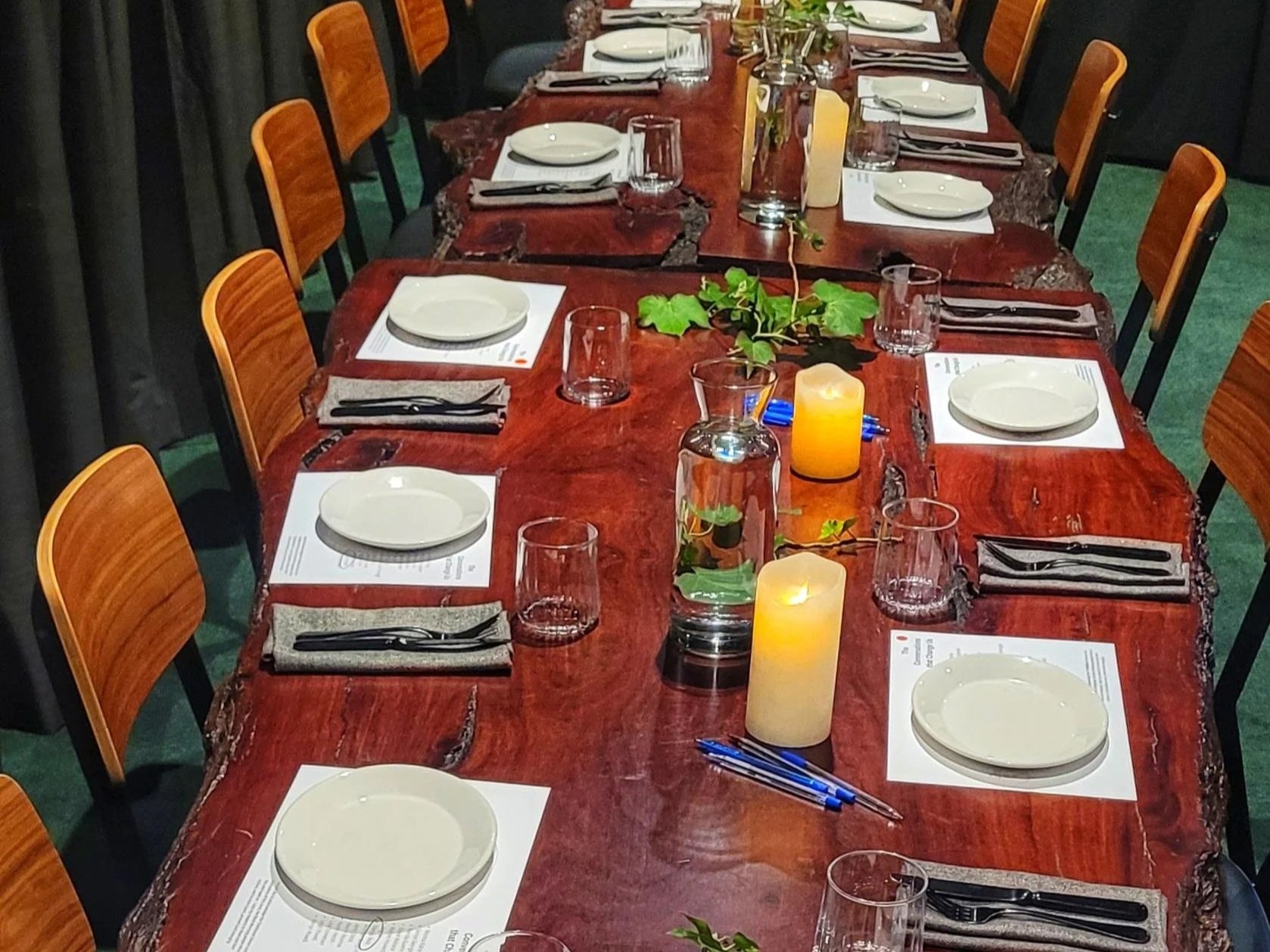
Last week, around a dinner table in Melbourne, it happened again. Thirteen men and women. A handful of questions on a table mat that I created prompted them to think about “ The Conversations that Change Us” .
Completely different answers from every person in the room. Two people told me afterwards that a single exchange had shifted something for them. Not a strategy session. Not a keynote. A conversation, with the right people, in a space designed for it.
That's not a special occasion. That's what becomes possible when you create the conditions and it is why I enjoy the work I do.
The Question Worth Asking
Have you ever considered that we engage in conversations throughout our lives that have the power to transform, not just our work, but the lives of the people around us?
That's not a grand claim. It's something I've seen play out in small rooms, around dinner tables, in workshops where someone puts a card on the table and asks a question that everyone answers differently.
The same question. The different answers. The heads nodding, sometimes in recognition, sometimes because a horizon just moved.
You could say I want to influence the way you view your conversations. To help you see them not as a soft extra but as the mechanism through which clarity, confidence, connection and opportunity actually travel.
The room has more thinking in it than most people realise. The question is whether we create the conditions to hear it.
What question, if asked in the right room, might change the direction of your thinking?
If you want to be in rooms where this kind of thinking happens regularly, the Catalyst Community is where I'm building that, or, if you have a team, my Silo Breaker workshops might interest you. You can find out more at kerryn-powell.com.au